The presence of permanent watercourses allows for the emergence of unique habitats shaped by specific ecological conditions. Factors such as terrain slope, water velocity, chemical composition, substrate size (gravel, sand, silt), temperature, and dissolved oxygen determine the composition of the flora and fauna in these environments.
- Alder, Willow, and Ash Forests on Siliceous Soils
In nearly direct contact with the water, a willow-alder forest develops, dominated by the grey willow (Salix atrocinerea), accompanied by other species such as the white willow /Salix alba) and the almond willow (Salix pedicellata). In areas with deeper soils and permanent flow, common alders (Alnus glutinosa) often appear, sometimes becoming abundant enough to give the formation the appearance of a true alder grove. The goat willow (Salix caprea) and the purple willow (Salix purpurea subsp. lambertiana) occur more rarely.
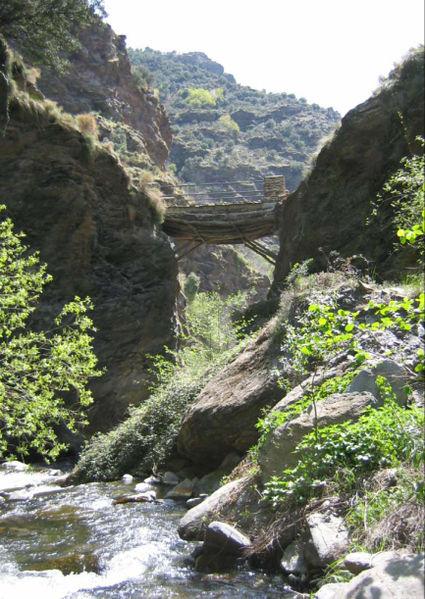
Beyond this, in an outer band (where river terraces exist), ash forests appear. These woods feature the narrow-leafed ash (Fraxinus angustifolia), black poplar (Populus nigra), Spanish maple (Acer opalus subsp. granatense), and wild cherry (Prunus avium).
As a fringe to these communities, a bramble-thorn scrub develops, featuring species such as the elm-leaf blackberry (Rubus ulmifolius), wild roses (Rosa corymbifera, R. canina), the Sierra Nevada blackthorn (Prunus ramburii), common hawthorn (Crataegus monogyna subsp. brevispina), Mediterranean red berry (Coriaria myrtifolia), Bupleurum fruticosum, and common ivy (Hedera helix).
Furthermore, numerous communities such as rush beds, bulrush beds, grasslands, and nitrophilous herblands thrive within this vegetation domain.
Notable within this area are the chestnut groves (Castanea sativa) associated with the main watercourses and the seepage from irrigation channels (acequias) and ponds. These forests are an integral part of the Sierra Nevada landscape, serving as vital habitats for local fauna and a source of economic wealth for the region.
- Elm, Poplar, and Willow Forests on Basic Soils
In the riverbeds of the carbonate-rich areas of Sierra Nevada, willow communities form the natural fringe of poplar groves toward the river interior. They also appear on the banks of streams and torrents as the sole woody vegetation covering these watercourses, which often have irregular flows and suffer from severe summer droughts. Notable willow species include Salix eleagnos subsp. angustifolia, S. purpurea subsp. lambertiana, and S. triandra subsp. discolor.
On soils that dry out but are periodically flooded, poplar or cottonwood groves are found. These only appear in small enclaves due to the narrowness of the Sierra Nevada river valleys and the fact that most small fertile plains (vegas) are used for horticultural crops.
These groves are often rich in white willows (Salix alba), which sometimes replace white poplars (Populus alba) in the tree canopy. Other frequent species include Rubus ulmifolius, Arum italicum, and Bryonia dioica.
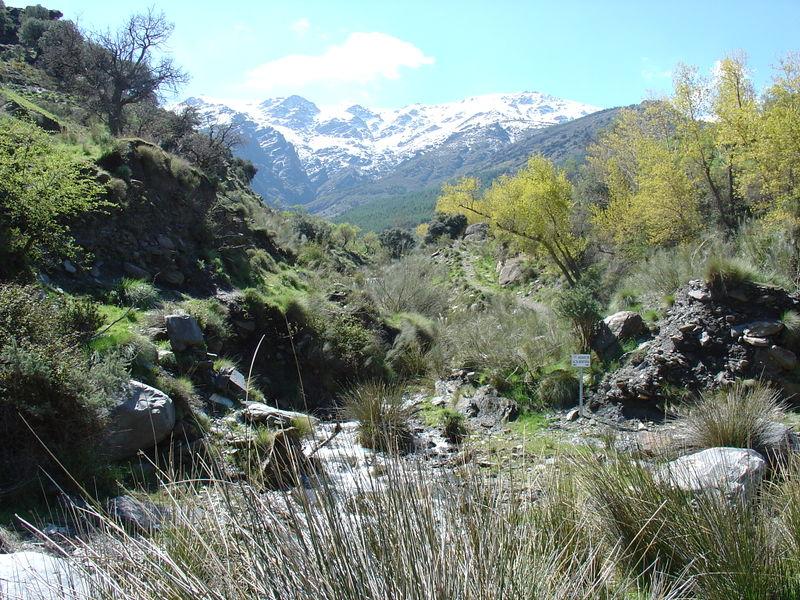
The sub-shrub fringes are dominated by thorny deciduous species, including blackberries, hawthorns, and wild roses, along with black bryony (Tamus communis), ivy, Spanish broom (Spartium junceum), and old man's beard (Clematis vitalba)
- Reed beds, rush beds, and nitrophilous herblands are prominently represented in the Padul Wetlands (Lagunas del Padul).
The most characteristic groups are perhaps the strictly aquatic invertebrates, which are highly diverse and play a vital role in the ecosystem. This includes various orders of insects such as mayflies (Ephemerella, Baetis), stoneflies (Perla, Leuctra), caddisflies (Hydropsyche), aquatic beetles (Gyrinus, Hydroporus), and water bugs (Gerris, Hydrometra).
Feeding on these invertebrates are vertebrates such as the brown trout (Salmo trutta), white-throated dipper (Cinclus cinclus), white wagtail (Motacilla alba), Eurasian water shrew (Neomys fodiens), Perez's frog (Rana perezi), and the Southern painted frog (Discoglossus jeanneae). Predators of these species include the grass snake (Natrix natrix) and the viperine water snake (Natrix maura).
Additionally, fauna associated with the riparian vegetation includes the Southern water vole (Arvicola sapidus), Eurasian golden oriole (Oriolus oriolus), common blackbird (Turdus merula), Sardinian warbler (Sylvia melanocephala), Eurasian wren (Troglodytes troglodytes), and Daubenton's bat (Myotis daubentonii).
Among invertebrates, striking beetles such as Aromia moschata and Eurythyrea micans stand out.
 EN
EN  ES
ES