Above 2,165 meters (7,100 ft), specific plant formations are found around watercourses. Physiognomically, these correspond to wet grasslands in summer, which remain covered by snow for much of the year.
These grassland formations, known locally as borreguiles, include—in a broad sense—not only hygrophilous grasslands but also communities specific to streams, springs, peat bogs, and headwaters. In our territory, the definition usually encompasses all mountain meadows with similar characteristics, including drier meadows surrounding true mat-grass lands (cervunales) and those thriving in waterlogged soils (mountain peat bogs).
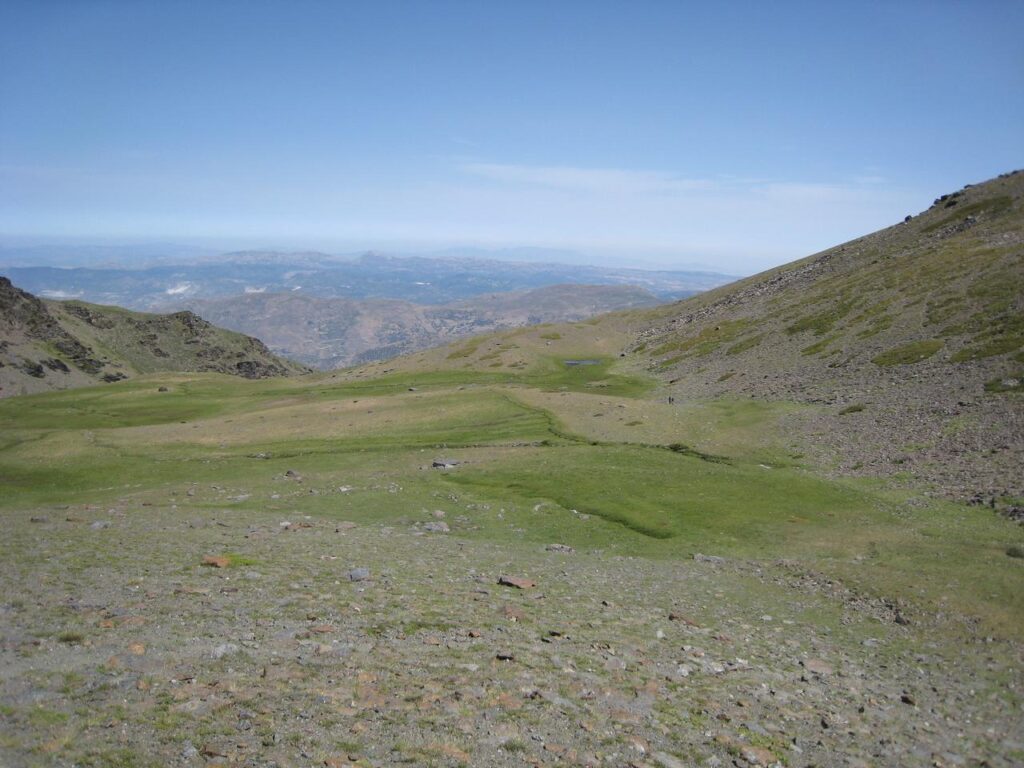
They are clearly distinct landscape elements. The most typical and extensive ones form in the remnants of ancient glacial structures. The flat bottoms of U-shaped valleys allow for low-gradient surfaces where water slows down or even stagnates, a phenomenon also seen near lagoons of glacial origin.
Beyond the fascinating and original plant communities that develop within them, borreguiles constitute an ideal biotope for species originating from cold and humid macroclimates. Species of boreal and alpine origin are frequent, along with numerous endemic species, most of which are derived from ancestors of similar northern or high-altitude provenance.
They hold great importance both for the landscape, providing vibrant color, and for livestock, as they are the primary source of summer pasture.
Different plant communities develop here, arranged according to the moisture gradient of the substrate:
- Dry Borreguil: Located on slightly moist soils, this is a grassland with medium coverage. Common species include Armeria splendens, Agrostis nevadensis, Potentilla nevadensis, the Sierra Nevada plantain or "snow star" (Plantago nivalis), and the "lion’s pelt" cushion plant (Arenaria tetraquetra subsp. amabilis).
- Dense Grassland: Found in areas with constant moisture throughout the summer. It is composed of species such as mat-grass (Nardus stricta), Festuca trichophylla subsp. scabrescens, Leontodon microcephalus, Luzula hispanica, Ranunculus demissus, and Campanula herminii.
- Incipient Peat Bogs: These are permanently waterlogged areas with anoxic conditions. They consist of communities rich in cyperaceous plants (sedges) such as Carex intricata, C. echinata, C.lepidocarpa subsp. nevadensis, Eleocharis quinqueflora, Festuca frigida, Triglochin palustris and Juncus alpinoarticulatus.
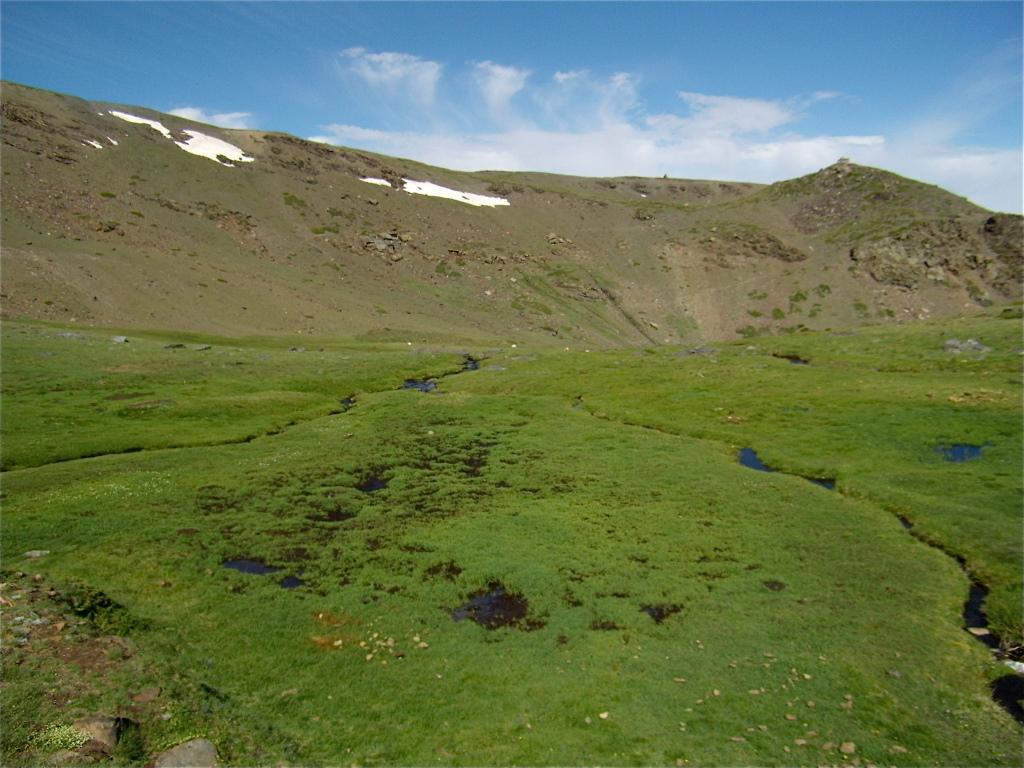
In areas with springs and headwaters, moss communities (Philonotis seriata, Polytrichum juniperinum, Brachythecium rivulare, etc.) stand out, forming striking light-green cushions. Among them, species like Saxifraga stellaris subsp. alpigena, Veronica turbicola, and Festuca rivularis appear.
In wet areas with deeper substrates and some degree of nitrification caused by livestock, megaforb (large-leaved herb) communities proliferate. These include interesting species such as the poisonous monkshoods or wolfsbanes (Aconitum burnatii and A. vulparia subsp. neapolitanum).
 EN
EN  ES
ES