Aims
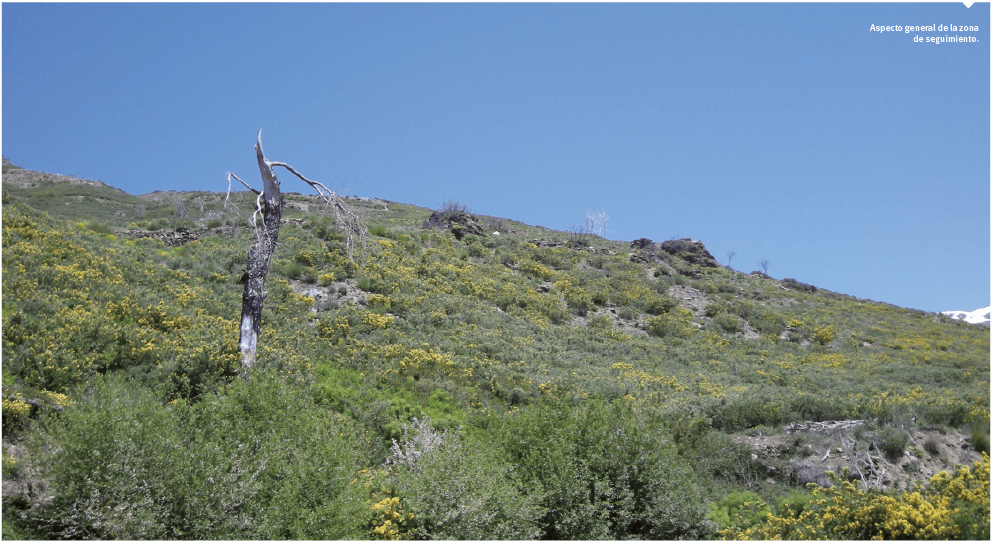
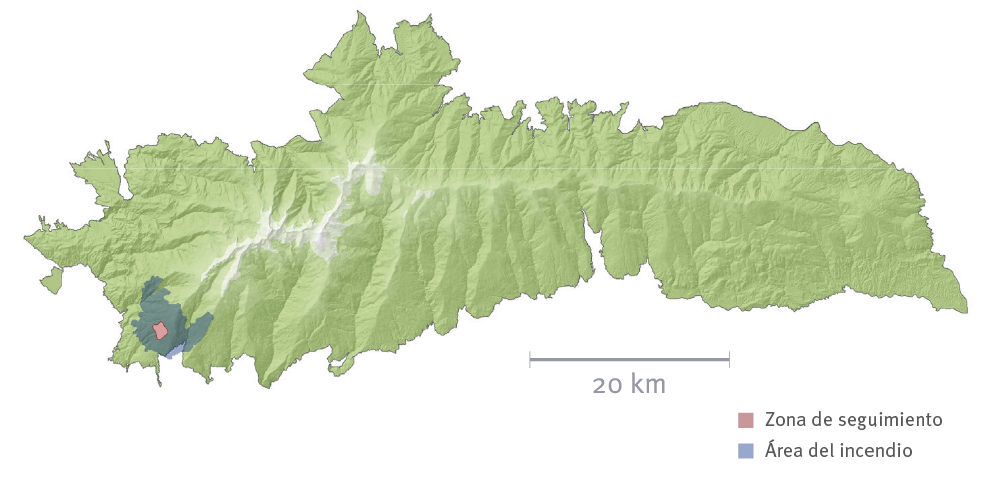
The general goal is to evaluate the effectiveness of a forest-restoration plan after a fire that burned some 3000 ha in the year 2005 and that affected mainly reforested pines.
The specific objectives are:
- To evaluate the effects of different techniques of restoring the forest area.
- To analyse the survival and differential growth of a diverse number of tree and shrub species used in restoration.
- To analyse the influence of pioneer shrublands and the height over the seedlings in the dispersion cores, taking into account survival, growth, and herbivory.
- To analyse the effect of elevation and exposure on the survival and growth of the young plants in the traditional reforested stands.
Method and effort
The experimental approach consists of monitoring the restoration through the dispersion cores and traditional reforested stands.
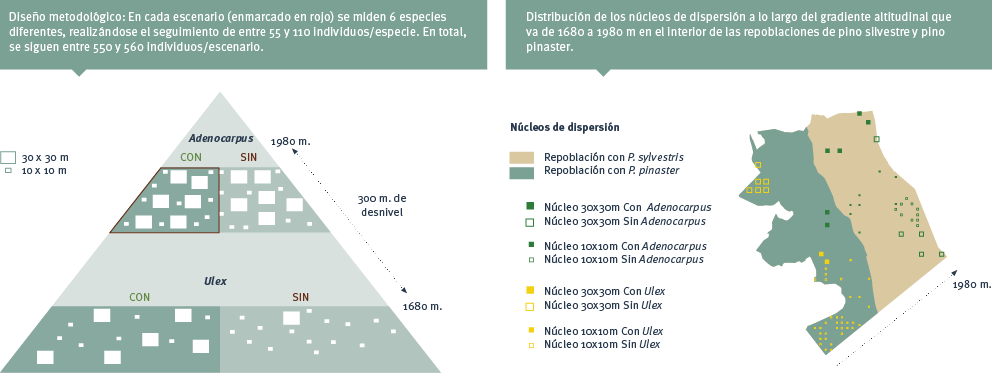
Dispersion cores: presentan unas dimensiones de 30×30 m y de 10×10 m. En ellos se ha introducido Crataegus monogyna, Rosa canina, Berberis hispanica, Prunus ramburii y Quercus ilex subsp. ballota, con una separación de 25, 50 y 100 m entre ellos. Cada uno de estos núcleos está rodeado de pinos (Pinus sylvestris en las cotas más altas y P. pinaster en las más bajas). El control de las seis especies introducidas se lleva a cabo sobre dos escenarios en cotas bajas (con y sin presencia de Ulex spp.) y otros dos en cotas altas (con y sin Adenocarpus sp.). En total se han marcado entre 55-110 individuos de cada una de las 6 especies y entre 550-560 individuos por cada uno de los cuatro escenarios. Además de la presencia o ausencia de matorral pionero (Adenocarpus sp. y Ulex spp.), también se ha evaluado la influencia de otros factores como la altitud y el tamaño del núcleo.
Traditional reforestation stands: in these, the same species are grouped in wooded areas of variable dimensions. The development of the population is evaluated in two areas: one on the southern slope at 1,540 m and another on the western slope at 2,140 m. In each area, 30 individual plants of the 6 species chosen were tagged individually for monitoring.
Periodicity
Individualized monitoring is undertaken twice yearly, once in spring and once in autumn, to evaluate winter and summer mortality, respectively.
References
Beschta, R. L., Rhodes, J. J., Kauffman, J. B., Griesswell, R. E., Minshall, G. W., Karr, J. R., Perry, D. A., Hauer, E. R. y Frissell, C. A. 2004. Postfire management on forested public lands of the western United States. Conserv. Biol., 18: 957-967.
Marañón-Jiménez, S., Castro, J., Kowalski, A. S., Serrano-Ortiz, P., Reverter, B. R., Sánchez-Cañete, E. P. y Zamora, R. 2011. Post-fire soil respiration in relation to burnt wood management in a Mediterranean mountain ecosystem. Forest Ecol. Manag., 261: 1436-1447.
Castro, J., Allen, C. D., Molina-Morales, M., Marañón-Jiménez, S., Sánchez-Miranda, A. y Zamora, R. 2011. Salvage logging versus the use of burnt wood as a nurse object to promote post-fire tree seedling establishment. Restor. Ecol., 19(4): 537-544.
 EN
EN  ES
ES