The Sierra Nevada Global Change Observatory is an institutional collaborative initiative between the University of Granada and the Regional Ministry of Sustainability, Environment, and Blue Economy of the Government of Andalusia. This joint effort has allowed for the consolidation, since 2008, of a monitoring program focused on the impacts of global change within the Sierra Nevada ecosystems, with the aim of transferring this scientific knowledge to the fields of management and society at large.
The design of the Global Change Monitoring program in Sierra Nevada was originally inspired by the conceptual framework and thematic areas proposed by the European initiative GLOCHAMORE (Global Change in Mountain Regions) (Grabherr et al. 2005). Our program was designed to identify the impacts of global change on key biophysical processes of mountain ecosystems, providing insights into change trends that allow us to understand and promote their adaptive capacity.
During the initial phase in 2010, the Observatory established a series of monitoring protocols under the scientific supervision of the UGR, with field data collection assigned to technicians from the Environment and Water Agency (AMAYA) and the technicians and environmental agents of the Sierra Nevada Natural Area. In addition to these protocols, which remain active today, the Observatory is responsible for compiling all information obtained by scientists from the University of Granada and other research institutions over recent decades in Sierra Nevada. These consist of time series of highly diverse biophysical data (climate, aerosols, biodiversity, ecological processes in aquatic and terrestrial systems, historical and socioeconomic aspects, etc.) that allow us to monitor the health status of Sierra Nevada’s ecosystems and biodiversity within a global change context. The flow of data and scientific knowledge provided by research groups continues to grow thanks to projects led by the University of Granada in collaboration with the Provincial Council of Granada and the European LifeWatch-ERIC Infrastructure. The main monitoring results can be consulted in two publications: The Footprint of Global Change and The Landscape of Sierra Nevada. Additionally, citizen science is becoming increasingly relevant as a tool to involve society in generating useful data for science and management. A prime example is the “74 high-mountain glacial oases” campaign, which has seen great success in participation. Finally, the inclusion of public and private entities through collaboration agreements with the University of Granada is increasingly important, as seen in the compilation of climate data and historical information in Sierra Nevada.
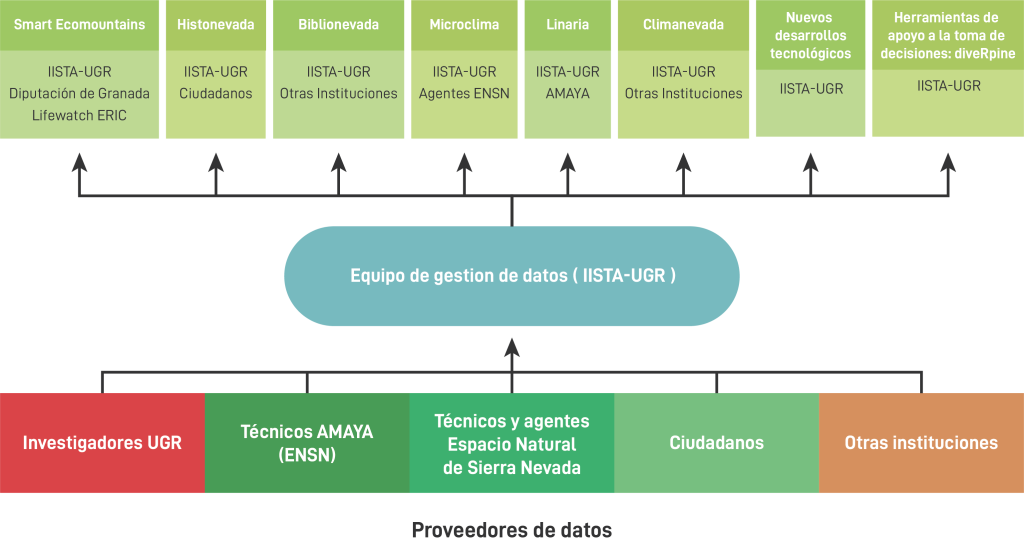
All collected information must undergo a validation, documentation, and harmonization process to be integrated and openly published in both institutional and international databases and repositories. This ensures that the data is Findable, Accessible, Interoperable, and Reusable (FAIR principles). Once this information is correctly managed, added value can be provided by generating applications and services that facilitate data use for different users (scientists, managers, and citizens). Both data management and the design and development of applications and services are tasks addressed by the data management team of the Andalusian Inter-University Institute for Earth System Research (IISTA-UGR).
Applications such as Climanevada, the Microclimate Network, Biblionevada, or Histonevada are designed to effectively collect and integrate information for the benefit of society. CLIMANEVADA is a database of climate information in the Sierra Nevada region, whose main objective is the harmonization, documentation, and integration of climate data from multiple providers. HISTONEVADA is a web application for collecting and consulting historical images and documents related to biodiversity, landscape, the environment, and the use of natural resources in Sierra Nevada. BIBLIONEVADA is an application for collecting and consulting scientific production published from 1970 to the present on biodiversity, the environment, and ecological aspects derived from global change in Sierra Nevada. LINARIA is the Observatory's information system where information from monitoring protocols is stored, along with other biodiversity-related data. Data is entered through web forms specifically designed for each protocol. Linaria allows for the digitization and storage of data, as well as long-term preservation and accessibility for users. SMART ECOMOUNTAINS is an institutional project of the University of Granada associated with the LifeWatch-ERIC European Research Infrastructure and the Provincial Council of Granada to develop a thematic center on mountain ecosystems with international reach, using Sierra Nevada as a case study.
Monitoring global change is a task that increasingly requires a multidisciplinary approach, with teams working transversally. To this is added the incorporation of new technological advances (remote sensors, new information and communication technologies, Artificial Intelligence, etc.), which multiplies the potential of applications and services to generate useful information for society and policymakers. The direct participation of society through citizen science initiatives is also gaining increasing prominence.
Information Management and Application Development
The data management team (IISTA-UGR) is responsible for collecting and adding value to existing scientific-technical environmental information about Sierra Nevada. Data comes from various sources (e.g., in-situ observations, automated instruments, etc.) and a wide variety of providers: technical staff from the Sierra Nevada Natural Area, AMAYA technical staff, UGR and external researchers, other public and private institutions, citizens, etc. The main activity of the data management team is to develop data applications and services that improve information management, ensuring that data is Findable, Accessible, Interoperable, and Reusable (FAIR principles) and contributing to more open science for the benefit of society.
Climanevada
CLIMANEVADA is a climate information database for Sierra Nevada, whose main objective is the harmonization, standardization, documentation, and integration of existing climate data in the Sierra Nevada region. Through a web application with a simple and intuitive interface, it allows users to query and download information from the system by simply selecting the stations, variables, and the date range for which they wish to download data.
CLIMANEVADA aggregates climate data from more than thirty sources, including the Spanish Meteorological Agency (AEMET), CETURSA, the Directorate-General for Traffic (DGT), the SAIH Network of the Guadalquivir Basin, the SAIH Network of the Mediterranean Basin, and the Environmental Information Network of Andalusia (REDIAM), among others.
Histonevada
HISTONEVADA is a web application for the collection and consultation of historical images and documents related to Biodiversity, Landscape, the Environment, and the use of natural resources in Sierra Nevada.
Designed as a citizen science tool, HISTONEVADA features a simple and agile interface so that users can contribute both images (photographs, drawings, illustrations, posters, or engravings) and historical documents (books, articles, manuscripts, administrative documents, press/magazines, or cartography).
The goal of HISTONEVADA is to recover historical information that is highly useful for understanding the natural and anthropogenic changes that have occurred throughout the history of Sierra Nevada.
Biblionevada
BIBLIONEVADA is an application for consulting scientific production published in relation to Biodiversity, Environment, and ecological aspects derived from Global Change in Sierra Nevada between 1970 and 2022. Following queries in the Web of Science and Scopus databases, complemented by systematic searches in other search engines and scientific journals from the 70s-90s, we have compiled nearly 900 publications, involving more than 1,700 scientific authors from a total of 160 research institutions.
The application allows for the consultation of bibliographic references (both alphanumeric and graphical) based on fields such as “publication title,” “author/s,” “abstract,” “date,” “institution,” “journal or book name,” “keywords,” “research areas,” “Observatory thematic areas,” and “traditional categories.” The graphical query interface is user-friendly and agile, with charts automatically updating as search criteria are modified. Additionally, the application provides a form to submit publications to complete the bibliographic collection.
Microclimanevada
We have designed and deployed a network of micro-stations composed of sensors with the aim of monitoring temperature and humidity variations at a microclimatic scale. These units operate indefinitely (dual-powered via solar panel and battery) and autonomously. Furthermore, given their features, any failure or degradation of their functions is detected in real-time, facilitating rapid repair. The measurement interval is every 30 minutes, and information is transmitted every 6 hours (thus optimizing battery use).
In each micro-station, we measure humidity and temperature in four microhabitats:
- Under Soil: 40 cm below the soil
- On the soil surface: on bare soil
- On the soil surface, but protected by: a) Under a stone in a forest clearing, or b) under leaf litter in an oak forest or high-mountain shrubland
- Air: 80–100 cm above the ground
Linaria
Linaria (https://linaria.obsnev.es/) is the institutional Information System of the Global Change Observatory of Sierra Nevada. It consists of a relational database management system (RDBMS) based on PostgreSQL/PostGIS where information from monitoring protocols is stored. Data are entered through web forms specifically designed for each protocol. In addition, Linaria covers other functionalities such as permission management, customized data downloads, taxonomic information management, spatial information visualization, etc. The objective of Linaria is not only to digitize and store data, but also to preserve information in the long term and make it accessible to users.
Smart EcoMountains
Smart EcoMountains is an institutional project of the University of Granada associated with the European Research Infrastructure LifeWatch-ERIC to develop a Thematic Centre on mountain ecosystems with an international scope, using Sierra Nevada as a case study. The objectives of Smart EcoMountains are:
- To generate information on biodiversity, ecosystem services, and global change in mountain ecosystems.
- To develop new technological tools and services that facilitate scientists in sharing, locating, accessing, and analyzing data, in order to improve our knowledge of mountain ecosystems and the main global change processes affecting them.
- To create educational content and management tools that inform society about the most important global change processes affecting biodiversity and ecosystem services in mountain areas, supporting managers, policymakers, and citizens in science-based decision-making.
 EN
EN  ES
ES